Official standard checked 23 July 2026
The current KUSA and FCI standard
The Kennel Union of Southern Africa adopted the latest FCI Irish Wolfhound standard with effect from 1 July 2026. This summary explains the official standard in our own words; the linked KUSA and FCI documents remain the authoritative texts.
Type, balance and temperament
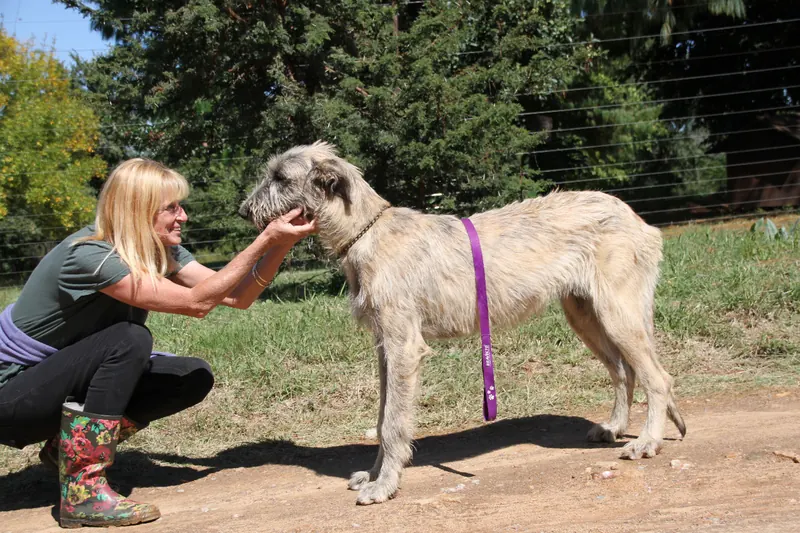
An Irish Wolfhound should be imposing without being massive or cumbersome: a rough-coated, Greyhound-like galloping hound that combines power with speed, active movement and graceful construction. Courage is part of the breed's heritage, while behaviour should be steady and manageable.
Head and body
The head is long and level, with a moderately pointed muzzle, strong jaws and a scissor bite. Small rose ears are preferred. The neck is long, strong and arched; the chest is deep and moderately broad; the body is long and well ribbed back, with a slightly arched loin and a well-drawn-up underline. The tail is long, gently curved and well coated.
Limbs, feet and movement
Shoulders should be muscular and sloping, forelegs straight and strong, and hindquarters long, powerful and correctly angulated. Feet are moderately large and round, with arched, tight toes. Movement should be easy, active and true, with enough reach and drive for a working galloping hound.
Coat, colours and markings
The coat is rough and hard on the body, legs and head, with particularly wiry hair over the eyes and beneath the jaw. Recognised colours are grey, brindle, red, black, pure white, fawn and wheaten. White is permitted on the forechest and toes, and as a slight marking on the tip of the tail.
Health, soundness and faults
Any departure from the standard is judged according to its seriousness and its effect on the hound's health, welfare and ability to perform its traditional work. The official fault list includes poor balance or muscle, weak or incorrectly placed limbs, twisted feet, a short body or neck, an overly broad or narrow chest, excessive dewlap, a curly tail and inadequate pigmentation.

The Bilkau ideal
Bilkau's traditional breeding aim is for mature hounds to reach at least 80 cm and 55 kg for males, and 75 cm and 48 kg for females. These are Bilkau's own kennel aspirations – not the official KUSA minimums, and not grounds on which a smaller but otherwise standard-compliant hound is automatically excluded from competition.
Size is never pursued in isolation. The aim is a sound, athletic and even-tempered Irish Wolfhound whose substance remains in balance with movement, health and quality of life.